
Dental Implant vs Bridge vs Denture: Which Is Better?
Introduction
Dental Implant
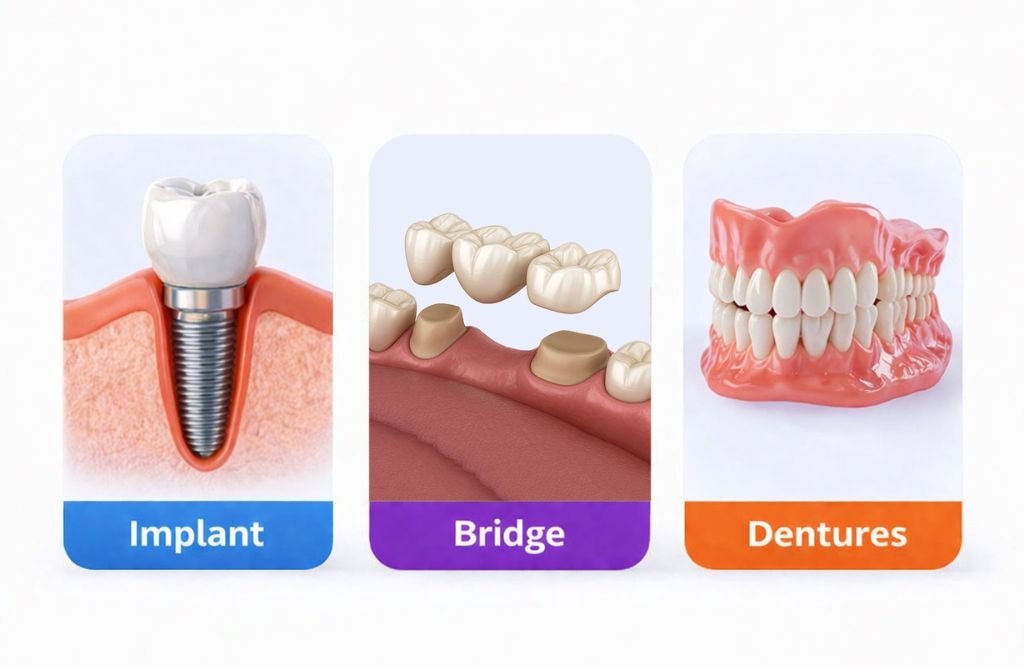
Dental implants are artificial tooth roots made of titanium that are placed into the jawbone. A crown can then be placed directly on the implant without touching the adjacent teeth. Unlike dental bridges, the neighbouring natural teeth remain completely untouched.
One of the biggest advantages of implants is that the bone grows and integrates around the implant, making it very stable and long-lasting. Dental implants can last for 10–20 years or even longer with proper care, and they have a success rate of over 97%.
Implants are considered a close-to-biomimetic option because they replace the missing tooth root and support the bone, similar to a natural tooth. However, they are not completely biomimetic because they do not have the periodontal ligament like natural teeth.
Depending on the implant system and bone condition, the healing period before placing the crown can range from 1 to 3 months. In some cases, especially with good bone support or when a patient is travelling, immediate loading (placing a temporary crown soon after implant placement) can also be done.
Remember this — “If the root is not replaced, the bone slowly disappears.”
Dental Bridge
A dental bridge is a traditional method of replacing one or more missing teeth. In this procedure, the teeth adjacent to the missing tooth are trimmed (reduced in size), and a bridge is placed over them to support the artificial tooth in between.
Dental bridges can restore chewing function and appearance, and the artificial tooth is made to match the colour and shape of your natural teeth. However, there are some important long-term considerations.
The biggest disadvantage is that healthy neighbouring teeth need to be ground down to support the bridge. These supporting teeth end up carrying the load of multiple teeth, which can put extra stress on them. Over time, this may lead to sensitivity, fracture, or even the need for root canal treatment in those teeth.
Another important factor is that the missing tooth area does not have a root, so the bone in that region slowly shrinks over time because there is no stimulation to the bone.
Dental bridges typically last around 7–10 years, after which they may need replacement. Also, if one of the supporting teeth develops a problem, the entire bridge may need to be replaced, which can increase the long-term cost.
Bridges are still a good option in certain situations, especially when implants are not possible due to medical conditions, insufficient bone, time constraints, or financial considerations.
“A bridge replaces the tooth above the gum, but it does not replace the root.”
“With a bridge, two teeth support three teeth.”
Dentures (Removable Partial & Complete Dentures)
Dentures are a removable option for replacing missing teeth. They can be either partial dentures (when some natural teeth are present) or complete dentures (when all teeth are missing). Dentures sit on top of the gums and are supported by the surrounding soft tissue.
This is one of the oldest methods of replacing missing teeth. While dentures can improve appearance and help with basic chewing, they do have some limitations.
Natural teeth are designed to be anchored inside the bone through roots. This stimulation helps maintain the height and width of the jawbone. Dentures, however, sit on top of the gums and do not replace the root. Because of this, the bone underneath slowly shrinks over time.
As the bone shrinks, dentures may become loose, uncomfortable, and may require frequent adjustments, relining, or replacement over time. This is why denture fit tends to change over the years.
Dentures are still a suitable option in certain situations, especially when multiple teeth are missing, when bone is not sufficient for implants, or when patients prefer a removable and more economical option.
“Dentures sit on the gums, but natural teeth come from the bone.”
Pros and Cons of Each Tooth Replacement Option
A Dental Implant vs Bridge vs Denture – Let us look at the factors that will help you determine which option to go with:
Dental Implants
Dental implants are very stable and can last for many years, even a lifetime, if they are maintained well. The biggest advantage of implants is that they replace the tooth from the root level. Because of this, the bone around the implant stays maintained and does not shrink over time. Also, the neighbouring teeth are not touched or damaged.
Implants may feel expensive initially, but in the long term, they are often a one-time investment. In a bridge, three teeth are involved (three caps), and if one tooth develops a problem later, the entire bridge may need to be replaced, which can increase the long-term cost.
Another advantage of implants is that they function very similarly to natural teeth and food does not get stuck underneath like it sometimes can with bridges.
In simple words: Implants replace the root, protect the bone, and do not damage neighbouring teeth.
Disadvantage: They require a minor surgical procedure, need healing time, and the initial cost is higher.
Dental Bridge
Dental bridges are a fixed option and are faster to complete compared to implants. They are also less expensive than implants initially.
However, the main disadvantage is that healthy neighbouring teeth need to be cut to support the bridge. These teeth take extra load, and over time they may develop sensitivity, decay, or may even require root canal treatment.
Also, since the missing tooth root is not replaced, the bone in that area slowly shrinks over time. Bridges usually last around 7–10 years, after which they may need replacement. Food can sometimes get stuck under the bridge and special cleaning aids are needed.
In simple words: A bridge replaces the tooth, but not the root, and it depends on the neighbouring teeth for support.
Dentures
Dentures are one of the most economical tooth replacement options available, initially and are commonly used when multiple or all teeth are missing. They are removable and do not require surgery.
However, dentures sit on top of the gums and do not replace the root, so the bone underneath slowly shrinks over time. Because of this, dentures may become loose over the years and may need relining or replacement.
As the bone shrinks, the face height (vertical height) reduces, which can make a person look older over time. Dentures can also move while chewing, speaking, or yawning, and some patients find them uncomfortable.
In simple words: Dentures sit on the gums, so the bone slowly shrinks and the fit becomes loose over time.
To end — you need to know this as a patient
“The closer we get to replacing the tooth from the root, the more natural, stable, and long-lasting the treatment will be.”
This line helps you understand how important healthy, strong bone is to healthy teeth. So, if you have been looking for ‘Best dentist for implants near me’ online, please look no further. Instead, walk into Zen Dental Studio at Nallagandla — so our dentists can help address all of your concerns, under one roof. Also, remember that the best tooth replacement option you can go for depends on your overall health, bone strength, how you wish your teeth to look like, your budget and long term plans. So, talk to us today!
Frequently Asked Questions
Dental Implants are titanium posts placed into the jawbone to support artificial teeth. Bridges use adjacent teeth for support to replace missing teeth. Dentures are removable appliances that replace multiple or all missing teeth. Each option differs in stability, longevity, maintenance, and impact on surrounding teeth and bone structure.
Dental implants provide the most natural appearance because they integrate with the jawbone and support crowns that match surrounding teeth. Bridges also offer a natural look but rely on adjacent teeth for support. Dentures may appear less natural due to movement or fit issues, though modern designs have improved aesthetics and comfort.
Dental implants can last many years with proper care, as they fuse with the bone and function like natural tooth roots. Bridges have a shorter lifespan due to wear and dependence on supporting teeth. Dentures require periodic replacement or adjustment because of changes in gum shape and gradual bone loss over time.
Dental implants offer strong stability, preserve jawbone structure, and do not affect neighboring teeth. Bridges require alteration of adjacent teeth, and dentures may shift during use. Implants involve surgery and higher upfront cost, while bridges and dentures provide faster, non-surgical solutions depending on oral health and patient preference.
Choice depends on factors such as the number of missing teeth, jawbone condition, budget, and overall oral health. Dental implants suit patients seeking a fixed, long-term solution. Bridges work for limited gaps with healthy adjacent teeth. Dentures are suitable for multiple missing teeth or full arch replacement with a removable design.