How to Choose a Good Root Canal Treatment: What Really Matters
Most people choose a root canal based on one factor — cost. But it is a treatment that is supposed to protect your tooth for the next 10–20 years or even more.
The difference between a routine root canal and a high-quality root canal lies in the details — the kind you cannot see, but your tooth will feel years later.
Let’s understand what truly determines the success of a root canal.
1. Isolation with Rubber Dam – Non-Negotiable
During a root canal, the tooth must be completely isolated from saliva and bacteria in the mouth.
Rubber dam isolation is required in several nations.
Without it:
- Saliva contamination can occur.
- Strong disinfectants cannot be safely used.
- Infection control becomes compromised.
2. Proper Disinfection is the Heart of the Treatment
The ideal disinfectant used worldwide is 5–6% sodium hypochlorite. Sodium hypochlorite (5–6%) is a strong disinfecting solution used during root canal treatment. It has a noticeable bleach-like taste and smell, but it is very effective at killing bacteria and dissolving infected tissue deep inside the canals, helping clean areas that instruments cannot reach.
In many dental practices, sodium hypochlorite is either avoided or diluted too much with saline because of its strong smell and taste. However, when it is overly diluted, its ability to disinfect the canal and dissolve infected tissue becomes much less effective, which can compromise the cleaning of the root canal. This is why using a rubber dam is important — it isolates the tooth and allows the solution to be used safely and effectively during root canal treatment.
Why activation matters inside every tooth
Root canals have
- Main canals.
- Tiny accessory canals.
Cleaning with files (instruments) cannot reach these tiny accessory canals.
That’s why ultrasonic activation of sodium hypochlorite is critical. It allows the solution to penetrate deeper into those tiny canals where the instruments can’t reach and it disrupts bacterial biofilm.
Laser-assisted disinfection can further reduce bacterial load in inaccessible areas.
Electronic apex locators
If cleaning goes:
- Beyond the root → post-operative pain
- Short of the root → incomplete removal of infection
An apex locator helps in finding the true end of the root.
A 2D X-ray does not show the true anatomical end of the root.
The radiographic end of the root and the actual root end are often different.
Electronic apex locators help determine the exact working length.
Our gold standard electronic apex locators from J. Morita ensure:
- Accurate cleaning
- Prevention of over-instrumentation
- Reduced post-treatment discomfort
- Better long-term success
Precision can prevent post-operative pain.
Quality of files
- Prevents instrument breakage inside the canals
- Not all files are the same
Modern heat-treated NiTi rotary files and constant taper files
- Older Protaper files are quite thick and remove more tooth structure while cleaning the canal.
- Today, we prefer a more conservative approach. We only create a small pathway inside the tooth and keep most of the tooth structure intact. The main focus is on thorough cleaning and disinfection, rather than making the canal very wide, which can weaken the tooth and increase the risk of fracture.
- Modern heat-treated NiTi files are more flexible, so they prevent breakage inside the canals, adapt to curved canals, and reduce the risk of ledges and perforations.
Equally important:
- How many times the file is reused — instruments are very delicate and not designed to be used beyond the times mentioned by the manufacturer.
- Overused files increase the risk of breakage inside the canal.
- Quality treatment respects both material and protocol.
I cannot tell you how many patients come to our clinic with a broken instrument lodged inside the root canal from a previous treatment.
Magnification – Seeing What the Eye Cannot See
Root canals are microscopic spaces.
Without magnification:
- Extra canals may be missed
- Cracks may go unnoticed
- Calcified canals may remain untreated
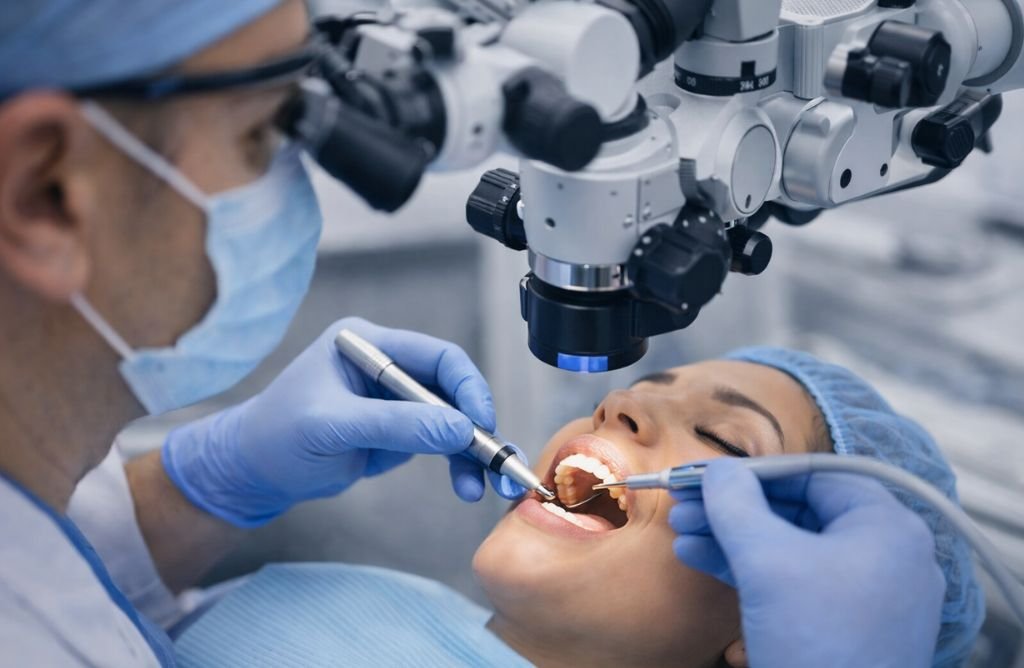
Dental microscopes or loupes help with:
- Detection of hidden or extra canals
- Safer cleaning
- Better precision
- Higher long-term success rates
CBCT – advanced imaging for challenging root canals
In complex cases, conventional X-rays offer limited resolution and clarity.
CBCT imaging helps:
- Identify extra canals
- Evaluate curved roots or complex anatomical variations of a root
- Detect hidden infections
- Plan retreatment accurately
Advanced imaging prevents guesswork.
The Sealer
After the canals are thoroughly cleaned and shaped, they are carefully sealed. A specialized sealer is used along with the filling material to close accessory canals and microscopic gaps that are not visible to the naked eye. This ensures a three-dimensional seal and helps prevent reinfection, improving the long-term success of the root canal treatment.
Traditional sealers:
- May shrink slightly
- Can dissolve slowly over time
- May compromise the seal years later
Modern bioceramic sealers:
- Are dimensionally stable
- Slightly expand on setting
- Bond chemically to dentin
- Are highly biocompatible
- Maintain long-term seal integrity
Long-term success of a root canal depends heavily on the integrity of the seal. If the sealer deteriorates, it can create pathways for bacterial leakage from the root end, leading to reinfection of the tooth.
The Coronal seal
You can have the best root canal in the world… but if the top seal is weak, the tooth can still fail in future.
A good coronal seal means placing a strong, well-sealed permanent restoration after a root canal. It prevents bacteria and saliva from leaking back into the cleaned canals.
This protects the root canal treatment and helps the tooth stay strong and infection-free for many years.
In many clinics, a basic GIC filling is placed after treatment. While acceptable as a temporary restoration, it is not strong enough for long-term load-bearing.
A well-sealed composite (resin) restoration:
- Bonds to the tooth
- Provides better strength
- Prevents microleakage
- Reduces chances of reinfection
And finally, a well-fit crown can prevent fracture of teeth and future reinfections.
Time, Precision, and Cost
A high-quality root canal requires:
- Advanced equipment
- Premium materials
- Single-use or controlled-use instruments
- Magnification
- Proper isolation
- Careful disinfection
- Time (it takes more time)
And time in healthcare is not a cost — it is safety
Quality dentistry cannot be rushed.
And anything done with precision, technology, and responsibility will never be the cheapest option.
So How Should You Choose?
Instead of asking:
“How much does a root canal cost?”
Ask:
- Is rubber dam used?
- Is magnification used?
- How is disinfection done?
- What sealer is used?
- How is the final restoration sealed?
- Is an apex locator used?
Conclusion
Now that you know how crucial it is for the whole process to be done in an error-free, meticulous manner, we hope you know who to call for help. Choosing the right dental clinic and dentist for root canal treatment is necessary — as dentistry is never only about taking care of your teeth alone or ensuring they look bright and clear. The right oral habits can help you keep your own teeth for decades and this can make you feel more confident about yourself too. So, if you have any toothy woes, reach out to us at Zen Dental Studio without any delay, as we are the best dental clinic in Hyderabad!
Frequently Asked Questions
Choosing a good root canal treatment involves more than comparing prices. The focus should be on accurate diagnosis, complete removal of infected pulp, thorough cleaning of the canals, and proper sealing to prevent reinfection. The dentist should perform detailed clinical evaluation and dental X-rays before starting. Clear explanation of the procedure, possible risks, number of sittings, and need for a crown reflects transparency. Clinics that follow strict sterilisation standards and provide structured follow-up care offer better long-term outcomes.
Yes, modern technology improves precision and comfort. Digital X-rays provide clearer imaging with lower radiation exposure. Apex locators help measure canal length accurately. Rotary instruments allow efficient cleaning and shaping. Magnification tools such as dental microscopes help detect hidden canals and cracks. Clinics that invest in updated equipment often deliver more predictable results. CBCT is valuable in complex root anatomy cases.
With effective local anaesthesia, the procedure itself should not be painful. Mild discomfort for 24 hours is common. In 95 percent of cases, our patients don’t feel any post root canal treatment discomfort. Severe or prolonged pain requires prompt dental review.
Success depends on complete removal of infection, proper sealing of canals, and placement of a well-fitted, high-quality crown. Patient factors such as oral hygiene and timely follow-up are key.